Real Systems.
Deployed & Working.
Three production systems built from scratch — each with a different architecture, each solving a real operational problem.
Production-Grade RAG System — 4-Workflow Knowledge Base That Ingests, Embeds & Answers From Your Own Documents
Most businesses have critical knowledge scattered across Google Drive, Notion, and internal docs — completely unsearchable by AI. I built a modular 4-workflow RAG system that automatically ingests documents from multiple sources, chunks and embeds them into a vector database, and exposes a conversational chat interface that answers questions with source citations and confidence scoring.

Enterprise teams sit on thousands of documents — SOPs, product specs, meeting notes, research — that no AI can access because they live in silos. Every time an employee or customer needs an answer, they search manually, ask a colleague, or get an outdated response. There's no scalable way to make institutional knowledge queryable without engineering a full RAG pipeline from scratch.
A modular 4-workflow system built in n8n: WF1 watches a Google Drive folder and auto-ingests new files (PDF, TXT, MD, DOCX) — detecting file type, downloading, chunking with 500-char windows and 50-char overlap, embedding via OpenAI, and upserting to Supabase pgvector. WF2 runs every 6 hours to sync all Notion pages — extracting block content, deduplicating old vectors by page ID, re-chunking and re-embedding. WF3 accepts manual ingestion via webhook — supporting both raw text and URLs, with HTML stripping and smart chunking at 600-char windows. WF4 is the chat interface: an agentic GPT-4o-mini orchestrator with 10-turn conversation memory that searches the vector KB with up to 3 query variations, produces structured responses with source citations and HIGH/MEDIUM/LOW confidence scores, and logs all queries and low-confidence gaps to Google Sheets for KB improvement.
WhatsApp AI Agent That Handles Text, Voice, Images & Documents — With CRM Logging and Human Handoff
Businesses lose leads and customers daily because WhatsApp messages go unanswered or get delayed. I built a fully agentic WhatsApp assistant that understands every message type, looks up customer history, answers from a knowledge base, books appointments, checks orders — and escalates to a human only when genuinely needed.
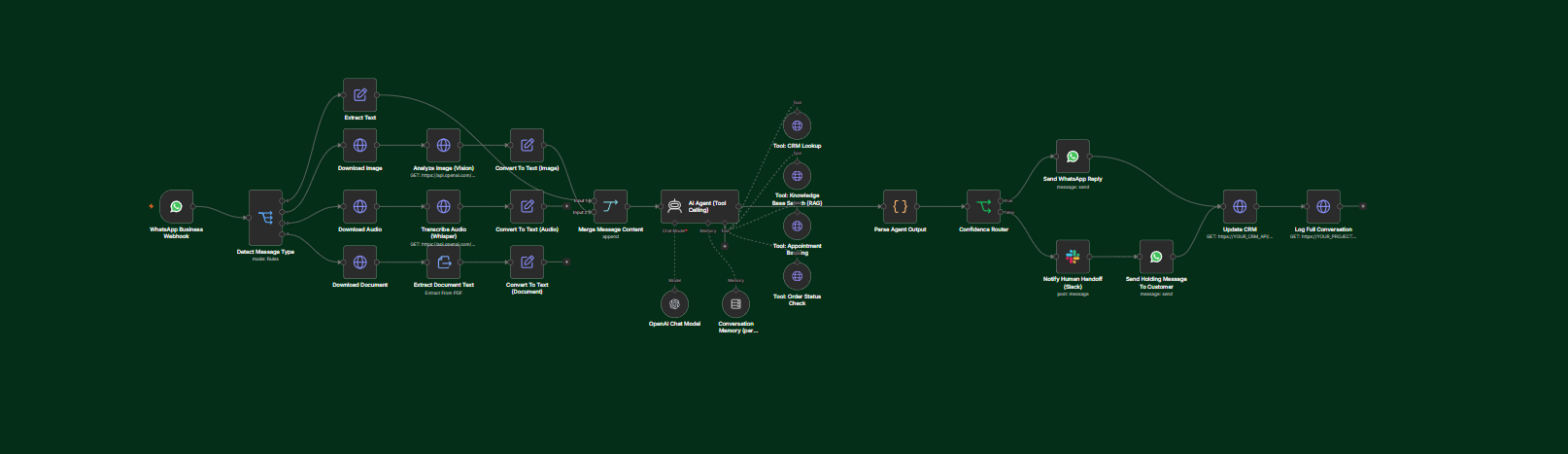
WhatsApp is the primary communication channel for millions of businesses globally — yet most handle it manually, with slow responses, no customer history, and zero consistency. Leads ask questions at 11pm and hear back in 48 hours. Support teams answer the same questions repeatedly. There's no record of who said what, and no way to scale without hiring more staff.
A WhatsApp Business Cloud API webhook triggers on every incoming message. A type-detection router branches into four parallel paths: text passes through directly; images are downloaded and described using GPT-4o Vision; audio messages are downloaded and transcribed via OpenAI Whisper; documents are extracted as text via PDF parser. All four paths converge into a single normalized message. A GPT-4o agent with 12-turn per-customer conversation memory then processes the message using four callable tools: CRM Lookup (customer history by phone), Knowledge Base Search (semantic RAG over company docs), Appointment Booking (calendar API), and Order Status Check. The agent outputs a structured JSON response with reply text, confidence score, needs_human flag, and intent label. A confidence router sends high-confidence replies directly via WhatsApp; low-confidence cases notify the team on Slack with a pre-drafted reply and send the customer a holding message. Every interaction updates the CRM and is logged to Supabase with full conversation context.
AI Invoice & Document Processing System — From Email Attachment to Approval Decision in Seconds
Finance teams spend hours manually keying invoice data, chasing approvals, and managing payment queues. I built a system that reads every invoice automatically using GPT-4o Vision, validates it against business rules, routes it to the correct approval tier, notifies the right people, and logs everything — with zero manual data entry.
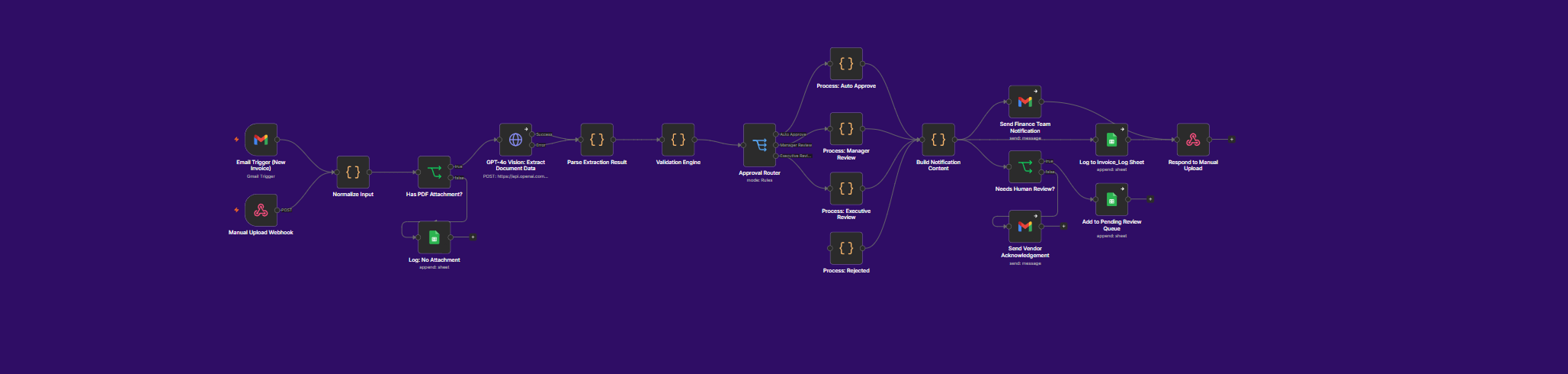
Finance teams at growing companies process dozens to hundreds of invoices weekly — each requiring manual data entry, verification against purchase orders, approval routing based on amount, and follow-up communication with vendors. Errors in keying amounts or missing due dates cost real money. The entire process is slow, error-prone, and entirely dependent on human availability.
A dual-trigger pipeline that accepts invoices from both email (Gmail) and manual upload (webhook). Every document is normalized into a consistent format, then passed to GPT-4o Vision with a structured extraction prompt that pulls 20+ fields: invoice number, dates, vendor details, line items, subtotal, tax, total, currency, payment terms, and PO reference — all as structured JSON. A Validation Engine applies business rules: mandatory field checks, math verification (subtotal + tax = total), overdue date detection, and amount-based approval tier assignment. Documents under $5,000 with 85%+ AI confidence are auto-approved; $5k–$50k goes to manager review; above $50k requires executive sign-off; documents with critical errors are rejected. The finance team receives a full notification email per document. Vendors receive an automated acknowledgement. Everything is logged to Google Sheets with 20+ fields per record, and non-auto-approved invoices are added to a Pending Review queue.
AI Lead Qualification Engine That Scores, Segments, and Follows Up — Automatically
Manual lead review kills response time and conversion. I built a pipeline that scores every inbound lead with AI, sends tiered outreach emails, and logs everything to a CRM — zero human effort.
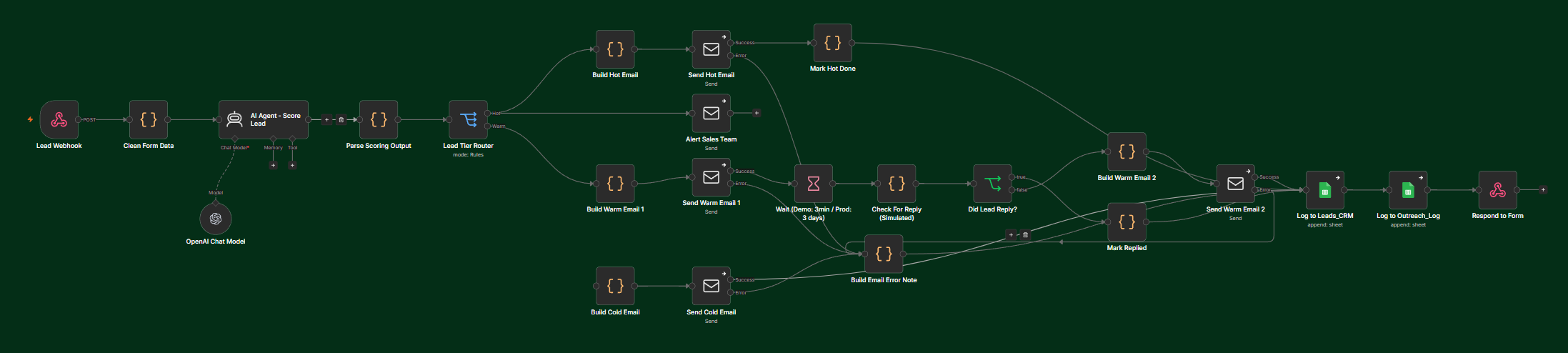
Sales teams treat every inbound lead the same — wasting time on cold leads while hot prospects wait too long for a response. Manual qualification doesn't scale.
A webhook-triggered n8n pipeline cleans lead data, scores it with GPT-4o-mini against ICP criteria (Hot / Warm / Cold), sends a tailored outreach email per tier via SMTP, waits for follow-up timing, checks for response, and logs every touchpoint to Google Sheets.
4-Agent Research System That Produces Full Business Reports in Under 3 Minutes
Manual market research takes hours and still misses things. I built a chain of 4 specialized AI agents that each handle one research dimension — then a synthesizer compiles a complete Google Doc report automatically.
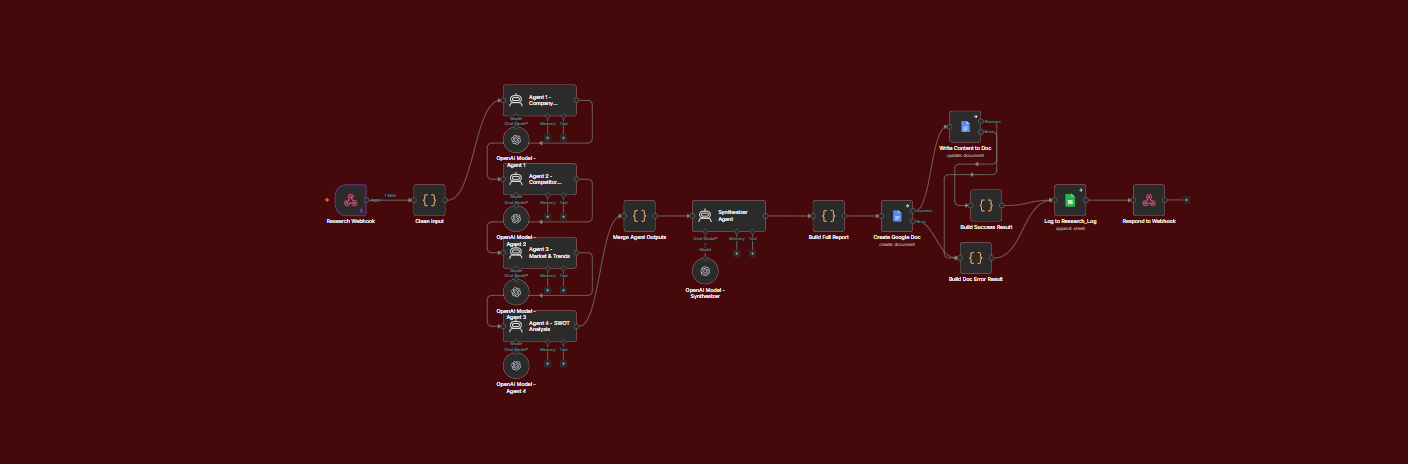
Business research — market overview, competitor analysis, market sizing, SWOT — takes a team hours to compile. The output is often inconsistent and never delivered fast enough for decision-making.
A webhook-triggered pipeline runs 4 specialized GPT-4o-mini agents in sequence: Overview Agent → Competitor Agent → Market Agent → SWOT Agent. Each passes context to the next. A Synthesizer agent combines all outputs, then the system creates a real Google Doc and writes the formatted report directly into it — all logged to Google Sheets.
AI Recruitment Agent That Screens Resumes, Scores Candidates & Sends Interview Invites — Automatically
Hiring teams waste hours manually reading resumes that don't match. I built an AI agent that reads every resume, scores it against the job requirements, routes candidates into tiers, and handles all follow-up emails — with zero human effort per application.
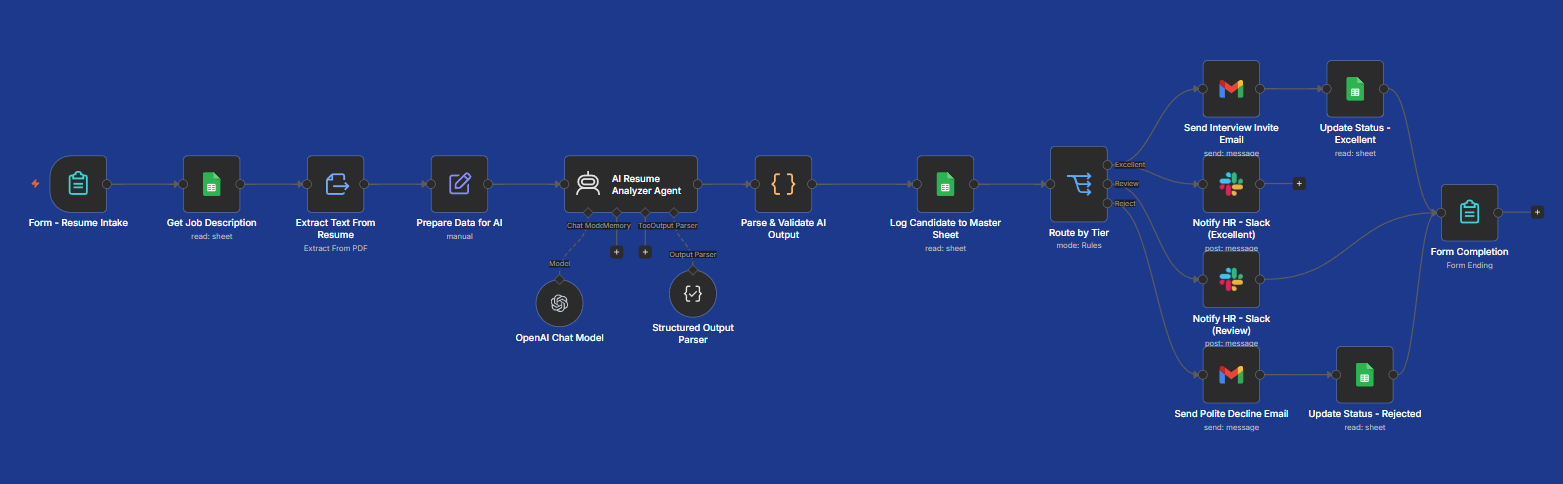
Recruiting teams spend hours reading resumes manually — most of which don't match the job requirements at all. High-quality candidates get lost in the pile, response times are slow, and the entire process depends on one person's availability and judgment.
A webhook-triggered pipeline receives each application, fetches the job description from Google Sheets, downloads and extracts text from the resume PDF, then runs it through a GPT-4o AI agent with a structured output parser. The agent scores the candidate 0–100 and assigns a tier: Excellent (interview invite sent automatically via Gmail + Slack alert to HR), Review (Slack alert for human judgment), or Reject (polite decline email sent automatically). Every candidate is logged to a master Google Sheet with full scoring details.
Agentic Support Engine With Vector Search, CRM Context & Self-Improving Feedback Loop
Support teams drown in repetitive tickets while high-value issues go unresolved. I built a fully agentic pipeline that classifies every ticket, retrieves live context from a vector KB and CRM, drafts a response using GPT-4.1, auto-sends when confidence exceeds 85%, escalates edge cases to Slack, and feeds every approved response back into the knowledge base — making the system smarter with every ticket resolved.
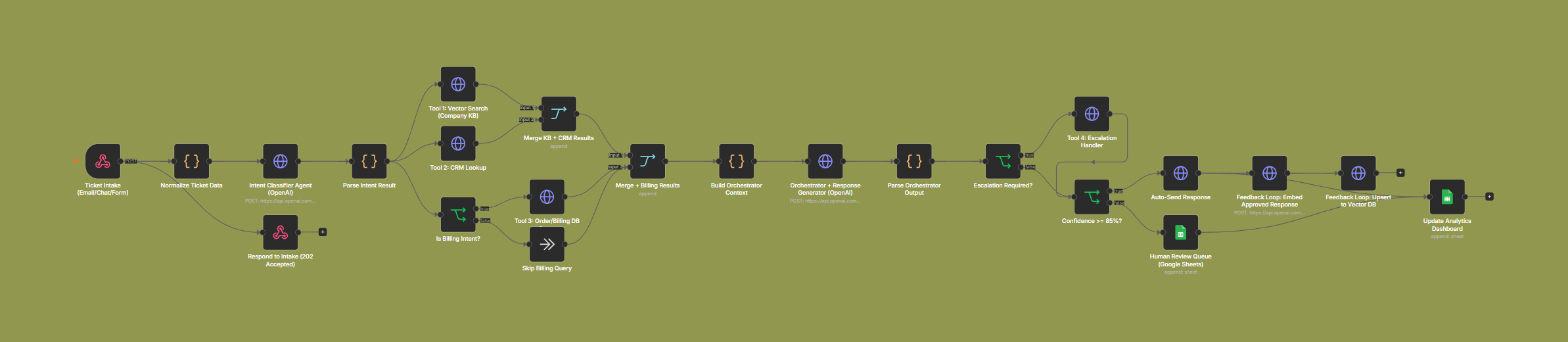
Support teams waste capacity on repetitive, low-complexity tickets — while truly urgent or complex issues compete for the same queue. Without intelligent triage, response quality is inconsistent, context is lost between tools, and there's no mechanism for the system to improve over time. Every ticket is handled from scratch.
A webhook-triggered pipeline normalizes incoming tickets from any channel (email, chat, form), then an Intent Classifier Agent (GPT-4.1-mini) categorizes the ticket as billing, technical, or general. Three tools run in parallel: a vector search against the company knowledge base (Supabase), a CRM lookup for customer history, and — for billing intents — a live order database query. An Orchestrator Agent (GPT-4.1) synthesizes all context and drafts a personalized response with an escalation decision. Tickets above 85% confidence are auto-sent; below that threshold, they're queued for human review in Google Sheets with a draft pre-filled. Every resolved response is embedded and upserted back into the vector KB, creating a self-improving knowledge loop. All outcomes are logged to an analytics dashboard.
AI Content Factory — Telegram-Powered Approval Pipeline That Publishes to Google Docs in One Tap
Content teams spend hours routing drafts for approval, making manual edits, and copying content across platforms. I built a Telegram bot approval handler that lets editors approve or request edits on AI-generated content with a single button tap — instantly creating a structured Google Doc and updating the content calendar.

Marketing teams generating AI content at scale face a bottleneck at the approval stage: drafts sit in email threads, edits are communicated verbally, publication is delayed, and the content calendar falls out of sync. There's no structured handoff between content generation and distribution — everything is manual after the AI does its part.
This is Part 2 of an AI Content Factory system. When AI-generated content is ready for review, the editor receives a Telegram message with inline Approve / Edit buttons. A single tap triggers the full approval pipeline: the workflow parses the callback, fetches the full content package from Google Sheets, assembles a structured document (blog post, LinkedIn, Instagram, X/Twitter thread, and email newsletter), creates a Google Doc, writes all formatted content into it, updates the content calendar status and doc URL in the sheet, and sends a Telegram confirmation with the live doc link — in seconds.